Hi, I shall use this blog to broadcast my opinions on anything entertainment, be it games movies music. Haters welcome, always up for discusions

Thursday, 19 January 2012

Pan's labyrinth

 
I was fortunate enough to catch Pan's Labyrinth last night as part of the 'Fright Fest' programme in London and was completely blown away. Guillermo Del Toro himself was present to both introduce the movie and to answer questions afterwards. He spoke very passionately about the film, and it was easy to see why. Guillermo Del Toro has created something very special - part war movie, part fantasy, that everyone should see. The film features a fantastic performance by Sergi Lopez as Captain Vidal and as central character Ofelia, newcomer Ivana Baquero delivers the performance of a seasoned veteran. If you are the type of person who is put off by subtitled movies, don't be. This is a very 'visual' film that does not rely overly on dialogue. This does not open until 24 November in the UK and 29 December in the USA but already I am looking forward to seeing it again (and buying the Special Edition DVD).This is the first time I've felt the need to write a review on here. Do yourselves a favour and go and watch it on the big screen.

Wednesday, 18 January 2012

The Girl with the Dragon Tattoo


Saw both films and read the trilogy.

I was skeptical adaptation about a Hollywood adaptation of the novel after having seen the Swedish film and loving it. However, Fincher has crafted a film that is outstanding in its own right.

And after falling in love with Noomi Rapace as Lisbeth Salander I didn't think that I could see anyone else in the role, but Mara nails it and creates an interpretation of Salander all her own.

I wouldn't say that Blomkvist as played by Daniel Craig is better, but the novels continually describe how handsome the character is and how many women he beds. I never believed that Michael Nyqvist inhabited those aspects of the character even though his performance in all other areas was admirable. Craig as Blomkvist does possess a charisma that his Swedish counterpart did not.

Hopefully this film will perform well, as I would like to see this team continue with adaptations of the rest of the trilogy.

Tuesday, 17 January 2012

Haywire

 
Greetings again from the darkness. Caught an early screening of this one and my quick description is that it's a mash-up of The Bourne Identity, Salt, and the original Mod Squad (a retro feel). In other words, it's a fun ride full of stunning fight scenes filmed with an artistry only director Steven Soderbergh can achieve.

Newcomer Gina Carano stars as Mallory Kane, an independent contractor ... the type who handles dirty work for governments and powerful people who must keep their hands somewhat clean. She gets double-crossed on a Barcelona job and becomes the target herself while in Dublin. So this lethal weapon goes on a globe-trotting mission of revenge and messes up people and hotel rooms in the process. If you think a woman can't carry action scenes, then you don't realize Ms. Carano is an MMA fighter. She is the real deal. Her physical skills are on full display and leave little doubt as to her deadly talent.

Since this is a Soderbergh film, you know the cast is well-stocked. We get Michael Douglas, Antonio Banderas and Ewan McGregor all at their smarmy best. Additionally we see Michael Fassbender, Channing Tatum and Bill Paxton (as Mallory's father). Trust me when I say not all of these character fare so well in their showdowns with Mallory. Though the script from Lem Dobbs is pretty basic, Soderbergh's way of telling the story is compelling enough to keep us interested between Carano's fights.

The color palette alternates between the brown/gold Soderbergh used for Traffic, and the blue/gray from his Ocean's franchise. The jazzy score from David Holmes is a wonderful compliment to the wide variety of scenes and locations, and the tongue-in-cheek humor is expert enough to keep you smiling through the all too serious business chats. A perfect example is the use of a particular S-word to both begin and end the movie.

Soderbergh is one of the few directors who refuses to get pigeon-holed into making a certain type of movie. Never short on style or visual flair, he touches many genres and here proves he can twist the action-thriller in a new, fun to watch direction. If you kick back and go for the ride, Haywire will show you a great time.

Sunday, 15 January 2012

Sherlock Holmes - A game of shadows


"Sherlock Holmes: A Game of Shadow" picks up where the prequel left off; Holmes is tracking down Professor Moriarty, a man he believes is responsible for a series of bombings and mysterious deaths around world. With the help of his pal Watson (off to be married soon), and a gang of gypsies, which includes The Girl with the Dragon Tattoo's Noomi Rapace, set out on a game of cat-and-mouse to find the schemes of the sinister Professor.

Though there is an element of mystery in this film, it is not as in-depth as the first film. Rather the focus is on the action sequences and clever humor. This is not necessarily a bad thing though; in fact it helps move the plot along. The first film suffered because the story was slow. In this Holmes though, there is not one second that drags. The story itself is not special, but its pace is what counts. Walking out of the theater, I felt refreshed and glad that I saw this movie.

Robert Downey Jr. and Jude Law are once again a true treat to watch as Holmes and Watson. Their chemistry and interactions are perfect; it's easy to tell that both had fun with the script and with each other. Jared Harris as Professor Moriarty gives a solid performance, as a cold, manipulative, power hungry villain. Unlike Mark Strong in the first film, he is a believable antagonist. Noomi Rapace is a nice flavor as Madam Sim.

The set and costume designs are exquisite, bringing to life of what Europe was like in the late 1800s. I smell Oscar for these departments. The sound and editing is crisply done, and the music is top-notched—Hans, you're truly the best. The visual effects are mostly good, but some scenes were a bit over the top and borderline ridiculous. One of many examples include a woman being thrown from a fast moving train into a river, without sustaining injury or even dying. This is impossible. Then again, it's Hollywood. The filmmakers aren't doing their job if a sense of the ridiculous is not thrown into an action flick from time to time.

"Sherlock Holmes: A Game of Shadow" delivers as a great, action-packed, and a rather humorous, popcorn loving flick. Note: the dog dies again.

In Time (2011) - Really good movie

We are all of us engaged in the trade of buying and selling time. When we stop smoking, we hope we are buying years. When we drink and drive, we are willing to sell a few years. But those are gambles with the odds. "In Time" is a science-fiction movie in which time is a fungible commodity. Are you willing to pay for 10 minutes of sex with an hour of your life?
The premise is damnably intriguing. Written and directed by Andrew Niccol, maker of such original sci-fi movies as "Gattaca" (1997) and "S1mOne" (2002), it involves once again people whose lives depend on an overarching technology. In this case, they can buy, sell and gamble with the remaining years they have to live.

The market in time is everywhere. On this imaginary Earth, humans have a Day-Glo digital clock on their forearms, clicking off the years, months, days and hours. It's like a population clock, except that it always grows smaller. By grasping hands and interfacing, I can upload and download time with you.

Justin Timberlake stars as Will Salas, a citizen of some unexplained future or parallel world (the settings and costumes are relatively contemporary), who finds himself on the run from the law. In this world, genetic engineering has been used to switch off everyone's body clock at age 25. At that point, they have one more year to live, but can work or make deals for more — or commit crimes. The 25-year limit had the curious effect of making everyone more or less the same age, which explains the sexy Olivia Wilde as Will's mother.

One day, Will has a conversation with a morose man named Henry Hamilton (Matt Bomer), who explains he is 100 years old and has another century in the bank. He's tired of living. Their conversation drags on into philosophical depths, until both fall asleep. Will awakens with an extra century on his clock and looks out the window to see Henry preparing to jump from a bridge. He runs out to stop him, is too late and is caught by a security camera, making him a suspect in the man's death.

The plot now interweaves Sylvia Weis (Amanda Seyfried), daughter of the richest man alive, Philippe Weis (Vincent Kartheiser), who has untold centuries on his clock and is essentially immortal. But enough about the plot.

The movie I suppose is an allegory in which time is money in a brutally direct way. For some of these people, time burns a hole in their pockets. For me, the most suspenseful scene involves a high-stakes poker game. Think about it. An opponent bets his whole pot: his life. Do you see him, or do you fold? If you lose, you're not broke, you're dead.

That said, a great deal of this film has been assembled from standard elements. Narrow your eyes to focus on them: Will Salas has the Identikit look of modern young action heroes: shaved head, facial stubble. For contrived reasons, he is paired with a beautiful young beauty and must drag her along with him as they're pursued by gunfire. The rich man moves nobly through a setting of opulence. The villain (Cillian Murphy) is androgynous and elegant, mannered in his cruelty. There are chases and so on. The only original element is the idea of timekeeping as a framework for these off-the-shelf parts. The only character of personal interest is Henry Hamilton.

Unanswered questions abound. The cars look like customized luxury boats from the 1970s; there's a Lincoln Continental with the slab sides but no nameplate. The time is said to be "the near future," yet Henry has already lived a century. Don't even think to ask about the mechanism of the timekeeping, or how human life is stored up in what look curiously like VHS cassette cases. And what of etiquette? Is allowing people to see your forearm as vulgar as flashing a big roll of cash?

Justin Timberlake continues to demonstrate that he is a real actor, with screen presence. But after the precise timing and intelligence he brought to "The Social Network," it's a little disappointing to find him in a role that requires less. He has a future in the movies.

Saturday, 14 January 2012

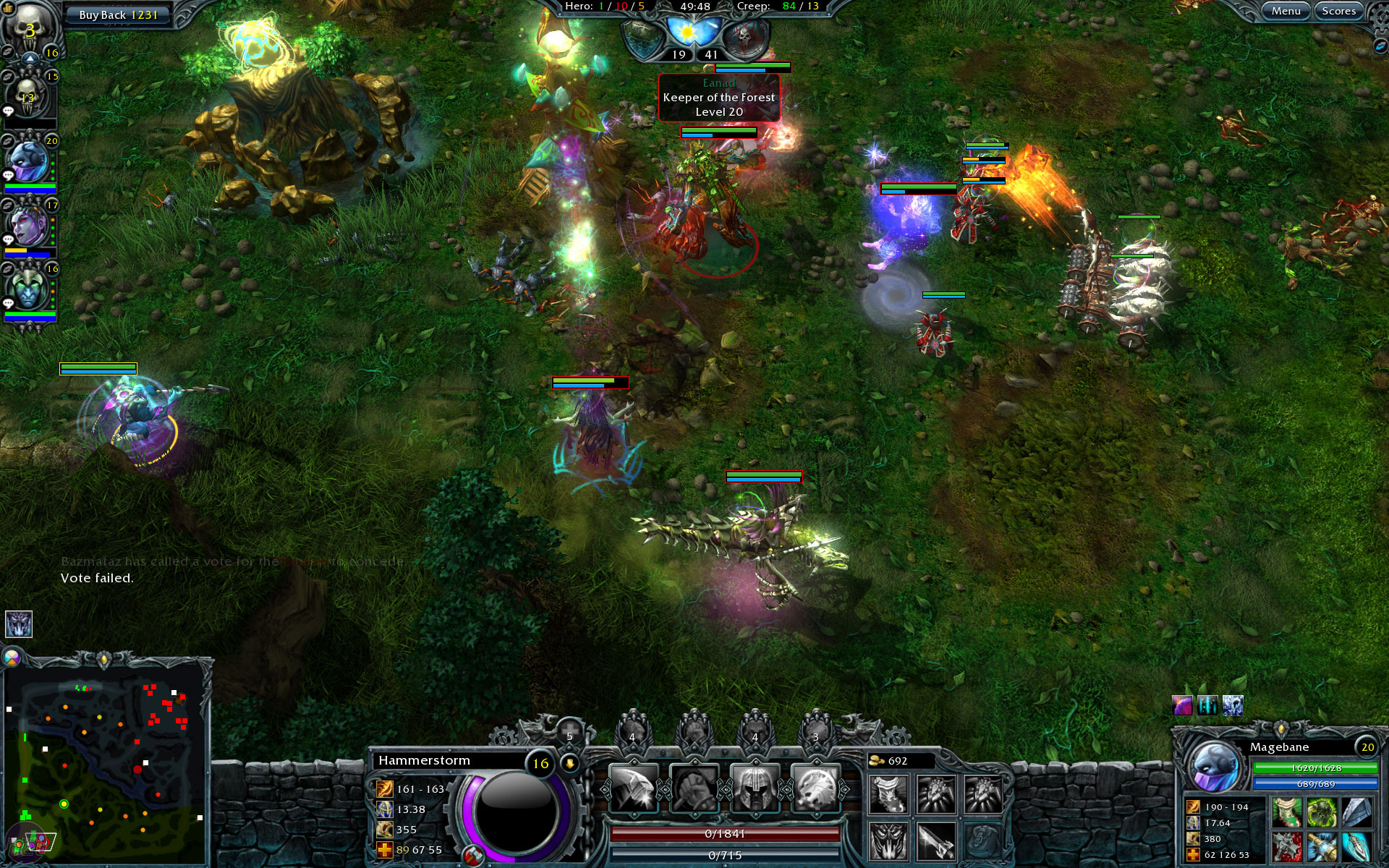
HON- Heroes Of Newerth

Hello readers, let me tell you a story. Once upon a time Blizzard released a game called Warcraft 3. It became very popular with online strategy gamers thanks to healthy support for user-made maps. These could completely change the way the game was played, ranging from Mario Kart-esque racing to tower defence challenges.

One map in particular though became more popular than all the others combined. Defence of the Ancients was a 5v5 hero war where players control just one unit. In fact, DotA, as the map became known, soon developed a following that eclipsed that of its parent game in much the same way that Counter-Strike became more popular than Half-Life. DotA was played at the World Cyber Games and even made an appearance at BlizzCon.


Heroes of Newerth Review
Click to enlarge

As DotA became increasingly popular (Basshunter even made a song about it, assault your ears here) it was only a matter of time before publishers came knocking and the original creators signed up with the likes of GOA, Valve and S2 to produce their own DotA spinoffs. We’ve already looked at GOA’s offering with the free play (or not) League of Legends and now the wraps have finally been taken off it's main competitor, Heroes of Newerth, following an extended beta test.

For those unfamiliar with the hero wars style of RTS it's pretty simple - at least on paper. Each of the two teams, here called the Legion and the Hellbourne, start in bases at diagonally opposite ends of the map. Connecting the two bases are three interconnected lanes and each team’s base will automatically churn out AI controlled units known as creeps which travel down these lanes and do battle with the opposition. The player’s role in this is to control a single hero unit in a team of five, killing enemy creeps and heroes, earning gold and experience to level up. When you're strong enough you can then push into the enemy base and destroy it. As we said, on paper it sounds painfully simple but in practice, it’s anything but.

Heroes of Newerth Review
Click to enlarge

Before we get into the gritty stuff though it’s worth asking just what can HoN bring to a genre that’s already dominated by DotA, a free to play mod (as long as you own Warcraft 3). The problems lie in the fact that DotA is shoehorned into what is now an eight year old game, with few of the features that players now expect.

This is where HoN comes in; adding much needed features and professional polish without interfering too much with the core DotA mechanics - consistent stat tracking is a particularly vital addition. The netcode has also been optimised to allow players whose PC crashes or internet connection goes down to rejoin the game once they’re up and running again; a genuinely fantastic addition. To top it all off, all this takes place in an entirely new 3D engine that makes Warcraft 3’s look its eight year age. There are a lot of long requested back end features tweaks too.

Thursday, 12 January 2012

Diablo 3, the game we have waited a decade for.

Diablo III picks up the story twenty years after the events of Diablo II. Mephisto, Diablo, and Baal have been defeated, but the Worldstone, which once shielded the inhabitants of the world of Sanctuary from the forces of both Heaven and Hell, has been destroyed, and evil once again stirs in Tristram. Playing as a hero from one of five distinct character classes, players will acquire powerful items, spells, and abilities as they explore new and familiar areas of Sanctuary and battle hordes of demons to safeguard the world from the horrors that have arisen.

Game Features:
  • Five powerful character classes to choose from, including the barbarian and witch doctor
  • Brand-new 3D graphics engine enhanced with spectacular visual effects and Havok physics
  • Numerous indoor and outdoor areas detailing new regions in the world of Sanctuary
  • Interactive environments with dangerous traps and obstacles, and destructible elements
  • Randomly generated worlds bolstered by scripted events for endless and dynamic gameplay
  • Vast assortment of fiendish monsters, with unique attack patterns and behaviors
  • New quest system and character-customization options for the ultimate action RPG experience
  • Multiplayer functionality over Battle.net with support for cooperative and competitive play

An interview with one of the D3 producer:
GameSpot: You joined Blizzard in 2006, but you're no stranger to the role-playing genre, having worked at Interplay and helping form Troika. What does experience with other development teams and a fresh set of eyes bring when you begin working on a game like Diablo III?
Leonard Boyarsky: I can't speak to how other people have approached the franchise in the past, because I didn't work with any of the previous designers, but when I approached it, I came in looking at it from a deeper story standpoint than I think it had in the past. Shockingly, I found out there was a deeper story there; it just really wasn't presented in the best possible format. There was huge dialogue, paragraphs and paragraphs of dialogue when you talk to an NPC, and it didn't grab me the way it could have in previous iterations. I came in, and [vice president of creative development] Chris Metzen and I had a lot of conversations about bringing the emotional resonance to the series. It was all there in the background, and we just wanted to bring it to the forefront.
GS: You've worn a lot of different hats in your development career: project lead, art director, designer, and writer. How has your own role flexibility helped with working across teams with different tasks?
LB: I think I speak pretty good artist [laughs] because I've had that experience in the past. I think it helps to have that experience when you talk about things you want to see in the world and your ideas. It also helps to know what is and what isn't possible.
GS: What are the non-negotiable elements that make up a Diablo game?
LB: For us, it's not so much on the story side; like I said, I feel like that's where Diablo had the most room for improvement, on story delivery. The action RPG side was where I think all the checkboxes were. It had to have a great item game, it had to have unrelenting action, it had to have mouse-breaking capabilities, it had to have all those things that people remember so fondly from the first two games, and I think I'm pretty confident we've accomplished that and brought it even further.
GS: Are those expectations challenges or opportunities? Were there any off-limit elements of the franchise when you started working on Diablo III, or was all previous work up for potential change?
LB: Everything was open. There were obviously things set in stone in terms of story and what the world was, but we wanted to open up the world into a lot of different areas and bring the story into some new areas. I think it was more of a mood and feel thing, where we ran into areas that we didn't want to touch, and it was more us searching around and trying to find that Diablo sweet spot for our story delivery and our tone. We knew what we wanted; we had a really good idea of what it was, but for us to put it down in a game and have other people feel that was the biggest challenge, I think. It took a lot of iteration. We were changing dynamics, the player now spoke a lot more, we delivered dialogue in a different manner; just all that stuff.
GS: Is that a constant challenge for you as developers--understanding the intentions of what you're trying to achieve, but not knowing how the audience will receive the content?
LB: I think early on it was a bigger issue, and through the iteration process we've really dialled it in. I think that's one of the things that we're fortunate of here at Blizzard; we have time to iterate and have great designers on other teams. Any game you're working on, just by the nature of the beast, you get too close to it to actually be able to see what you need to see. To have fresh eyes to look at it and give you feedback is invaluable. I think the challenge with Diablo that I've found, that's been a little bit more than some of the other games I've worked on, is the economy of delivery systems. We don't have a huge amount of dialogue with which to convey ideas, we don't have a lot of the RPG conventions that I fell back on in the past, like dialogue trees, to really convey a lot of the stuff, so for us to convey the mood and vibe in a really succinct manner was a really big challenge, but I think after a lot of iteration and a lot of great feedback from other designers I think we've pretty much hit it.

Sunday, 8 January 2012

Starcraft 2: Wings of Liberty

I have recently started watching some SC2 streems, of plays and tournaments. And let me tell you, i cant wait for the game expansion to be released, (either this or D3).
For those who dont know in StarCraft II, it's still the Terrans, Zerg, and Protoss clashing against each other, and you're still mining minerals with SCVs, Drones, and Probes and pulling Vespene Gas from the ground to fuel production. It's a classic style of real-time strategy play, one old-school RTS gamers should be very familiar with. Compared to the changes Blizzard made between the traditional gameplay of Warcraft II: Tides of Darkness and the hero-based leveling elements of Warcraft III: Reign of Chaos, StarCraft II feels like a relatively safe play; a game designed to slide in and discreetly supplant its predecessor instead of ruffle the feathers of longtime StarCraft devotees and risk rejection. While it's not a revolutionary game, it is one of the most fully featured, expertly designed, and impressively refined real-time strategy experiences on the market.

Even though at its most basic level a lot of the game is familiar, much has been adjusted. In no area is this more apparent than in the single-player campaign. Blizzard's decision to split the overall story of StarCraft II into three parts sparked some controversy when it was first announced; basically that means you only get to play as the Terran faction (with a few exceptions) for the solo portion, and must wait until later for the Zerg and Protoss campaigns to be released to see the entirety of the story. While that affects some of the impact of the tale, it in no way means you'll be starved for content if all you're looking to do in StarCraft II is play alone. There's a huge campaign here that could easily take many hours to play through (depending on your style and level of difficulty). It's all exceedingly well presented, with a totally reworked narrative delivery system, a few instances of choice driving the story, and options for inter-mission upgrades that make it feel like more of an role-playing experience than a series of mission that exist solely to get you ready for the multiplayer.
Unlike the original game, this time around you won't be staring at the sparsely animated heads of major characters as they bicker and plot on video monitors between missions. Instead, Blizzard gives you a detailed world to play around in to give its fictional universe a greater sense of place and atmosphere. The action follows along with Jim Raynor, who begins the game as a gruff alcoholic in the process of rebelling against Arcturus Mengsk, the corrupt emperor of the Terran Dominion. If you've forgotten the StarCraft storyline or never got around to learning it, then it should be fairly easy to dig into this one, though you're going to miss a lot of references.

Regardless of your level of exposure to the fiction, it's difficult to ignore the eye-rolling cliches and talk of prophecies being fulfilled, and the overabundance of 1980s action movie-style macho posturing and cheesiness. It's all snugly wrapped around the missions though, which makes it easier to look beyond the standard sci-fi trappings and appreciate the detail that's gone into the creation of the character models, the smoothness of the animations, and the amount of character interaction packed into the experience. Since missions are bookended by cut-scenes, great voice acting, and rewards, it makes each feel important in its own way, and adds to your motivation to meet every challenge. It's something a lot of developers besides Blizzard have difficulty doing in this genre, with their missions often feeling like a string of meaningless, boring tasks.

Additional narrative is also provided through interactive environments between missions. You're able to explore various settings, from a dusty building at the campaign's outset to Raynor's starship, the Hyperion, and beyond as the action continues. Eventually the entirety of the game's options and locations are unlocked, letting you flip around to different areas of the ship to talk to major characters or purchase upgrades. On top of that, new units are unlocked depending on which mission you choose to take on next, which can be further modified in the upgrade center, adding significant bonuses to each like more effective healing for medics or boosted protection for Marines. Because the campaign isn't tied down by the strict rules of multiplayer balance, this also means you'll see a number of favorites return from the original. Firebats, Vultures, Goliaths and more can be unlocked and upgraded in the story mode, which is both a great nod to fans and adds more variety for new players. It's a system that's constantly giving you new things to play around with and ways to modify what's already available, making progressions more exciting.

As if that wasn't enough, even more options for army customization exist throughout the campaign, including a research system and mercenary units. These mercs can be hired by Raynor for a fee, and when deployed in battle serve as elite versions of existing units that are called in instantly. It can be great in a bind, and adds to the stable of available fighters when setting up a battle plan. Optional objectives in missions call for the collection of Protoss or Zerg research items, which can then be turned in between stages for even more upgrades. Along both Zerg and Protoss paths these upgrades exist in pairs - where selecting one locks out the other - meaning you'll have to make permanent decisions about things like whether you want to buff the armor of a Bunker or slap a gun turret on top. All these modification systems combined make for a highly customizable campaign experience that's consistently fun because it introduces a steady stream of new content and options, making sure there's always something to look forward to trying out for the first time.